Small Talk on a Plane: 12 English Phrases for Business Travellers
Freeze when someone on a plane asks "Where are you flying to?" Learn 12 natural English small-talk phrases for business travel, and how to practise them out loud.
You've just sat down. Laptop bag under the seat, seatbelt on. The person next to you smiles and asks, "So, where are you flying to?"
And your mind goes blank.
You know the answer. You know the grammar. You could write it perfectly in an email. But in that moment, with a real person waiting, the words don't come. You say "London" and look at your phone.
I hear this story from professionals all the time. It isn't a grammar problem. It's a practice problem. If you've never said a sentence out loud, your brain can't find it when you need it.
So here are 12 phrases I'd want every business traveller to have ready, and, more importantly, how to make them come out automatically.
Why small talk on a plane matters
A short conversation with the person in 14B can feel unimportant. It isn't. You never know who you're sitting next to, and a friendly, confident answer makes a good impression on anyone.
And even when it doesn't lead anywhere, it's the easiest practice you'll get all year: low stakes, a friendly stranger, and a clear end when the plane lands.
The secret: answer, then ask back
Most people who freeze think they need to say something clever. You don't. Small talk has a simple shape:
- Answer the question in one sentence.
- Add one detail.
- Ask the same question back.
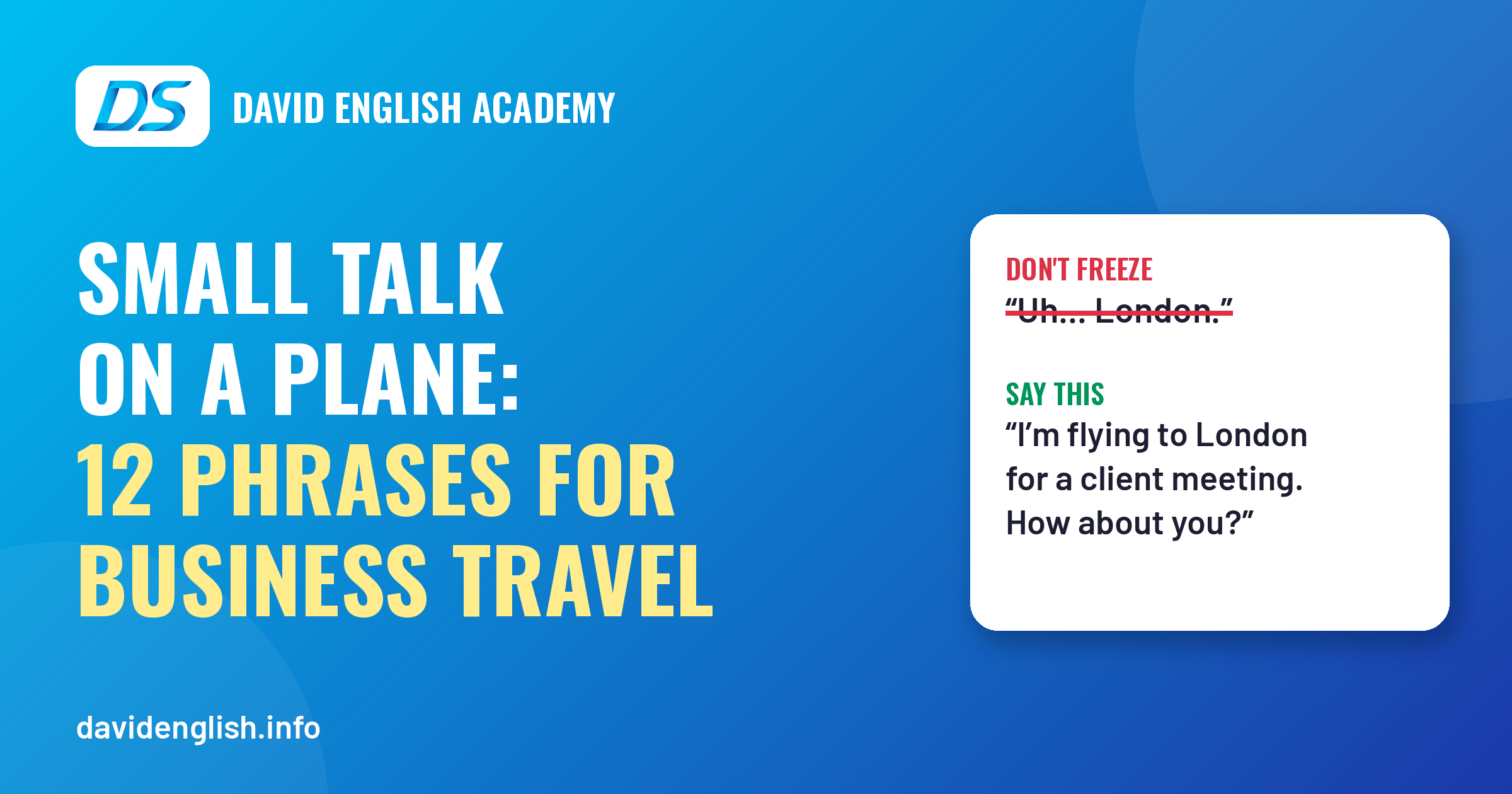
"I'm flying to London for a client meeting. How about you?"
That last part, "How about you?", is the most useful two words in small talk. It passes the conversation back, so the pressure is off you.
12 English phrases for small talk on a plane
Starting the conversation
- "Are you heading home, or travelling for work?" — friendly, and gives them two easy options.
- "Have you flown with this airline before?" — a safe, neutral opener.
- "Looks like a full flight today." — a comment, not a question. They can respond or not.
Answering "Where are you flying to?"
- "I'm flying to London for a client meeting. How about you?" — the phrase from my reel. Use the present continuous (I'm flying), not "I fly."
- "I'm heading to Frankfurt for a conference. It's my first time there." — the extra detail gives them something to ask about.
- "I'm going back home after a work trip." — simple and complete.
Keeping it going
- "What do you do, if you don't mind me asking?" — polite and natural. The "if you don't mind me asking" softens it.
- "Do you travel a lot for work?" — almost everyone has an opinion on this.
- "Any recommendations for things to do there?" — people love giving advice about their city.
Ending politely
- "I think I'm going to try to get some sleep. Nice talking to you." — the most useful exit line on any flight.
- "I've got some work to finish, but it was great chatting." — honest and friendly.
- "Enjoy your trip, and good luck with the meeting." — use it as you leave the plane. It shows you were listening.
Notice something? None of these phrases is advanced. You probably know every word. That's exactly the point: the problem was never vocabulary. It's having the sentence ready in your mouth, not just in your head.
Small mistakes I hear often
These won't stop a conversation, but they make your English sound less professional than you are:
- "I fly to London tomorrow." → I'm flying to London tomorrow. (Plans use the present continuous.)
- "I go for a meeting." → I'm going for a meeting.
- "What is your work?" → What do you do?
- "Nice to talk with you." → Nice talking to you. (Said at the end.)
How to make these phrases automatic
This is the part most phrase lists skip. Reading 12 phrases won't help you on the plane. Saying them will.
Here's how I teach it:
- Pick three phrases, not twelve. One opener, one answer, one exit line.
- Make them yours. Change "London" to where you really go. Change "client meeting" to what you really do. A sentence about your real life sticks.
- Say each one out loud three times. In the car, in the shower, walking to a meeting. Out loud, not in your head. Your mouth needs the practice too.
- Use one in real life this week. With a taxi driver, a colleague, a hotel receptionist. Once you've used a phrase with a real person, it's yours.
Your turn
Answer these out loud, in full sentences, as if someone just sat down next to you:
Where are you flying to, and why? Do you travel a lot for work? What's one thing you'd recommend doing in your city?
Then finish with: "How about you?"
If you answered without stopping to build the sentence, you're ready for your next flight.
Frequently asked questions
How do I start small talk in English with a stranger?
Start with something you both share: the flight, the weather, the delay. A simple comment like "Looks like a full flight today" is enough. If they respond, ask one easy question.
What should I say when someone asks where I'm flying to?
Answer in one sentence, add one detail, and ask back: "I'm flying to London for a client meeting. How about you?"
How do I end a conversation on a plane politely?
Give a reason and a kind closing: "I think I'm going to try to get some sleep. Nice talking to you." Nobody will be offended.
Why do I freeze when I speak English, even though I understand it?
Because understanding and speaking are separate skills. You've practised recognising English, not producing it. Saying sentences out loud, regularly, closes that gap. I wrote more about this in I understand what people say but still can't speak English.
Practise it out loud with JAM
Want to find out how your answer actually sounds? Try JAM, my 60-second speaking challenge. You speak for one minute and get instant AI feedback on your fluency, grammar and vocabulary.
Start with the question from this post: "Where are you flying to?"
Take the JAM speaking challenge
Which small-talk question makes you freeze? Try answering it in JAM first.