Reading vs Listening: What Actually Helps You Speak English Better?
Reading builds knowledge. Listening trains your ear. Neither replaces speaking. Here's how to use both so you stop freezing in meetings.
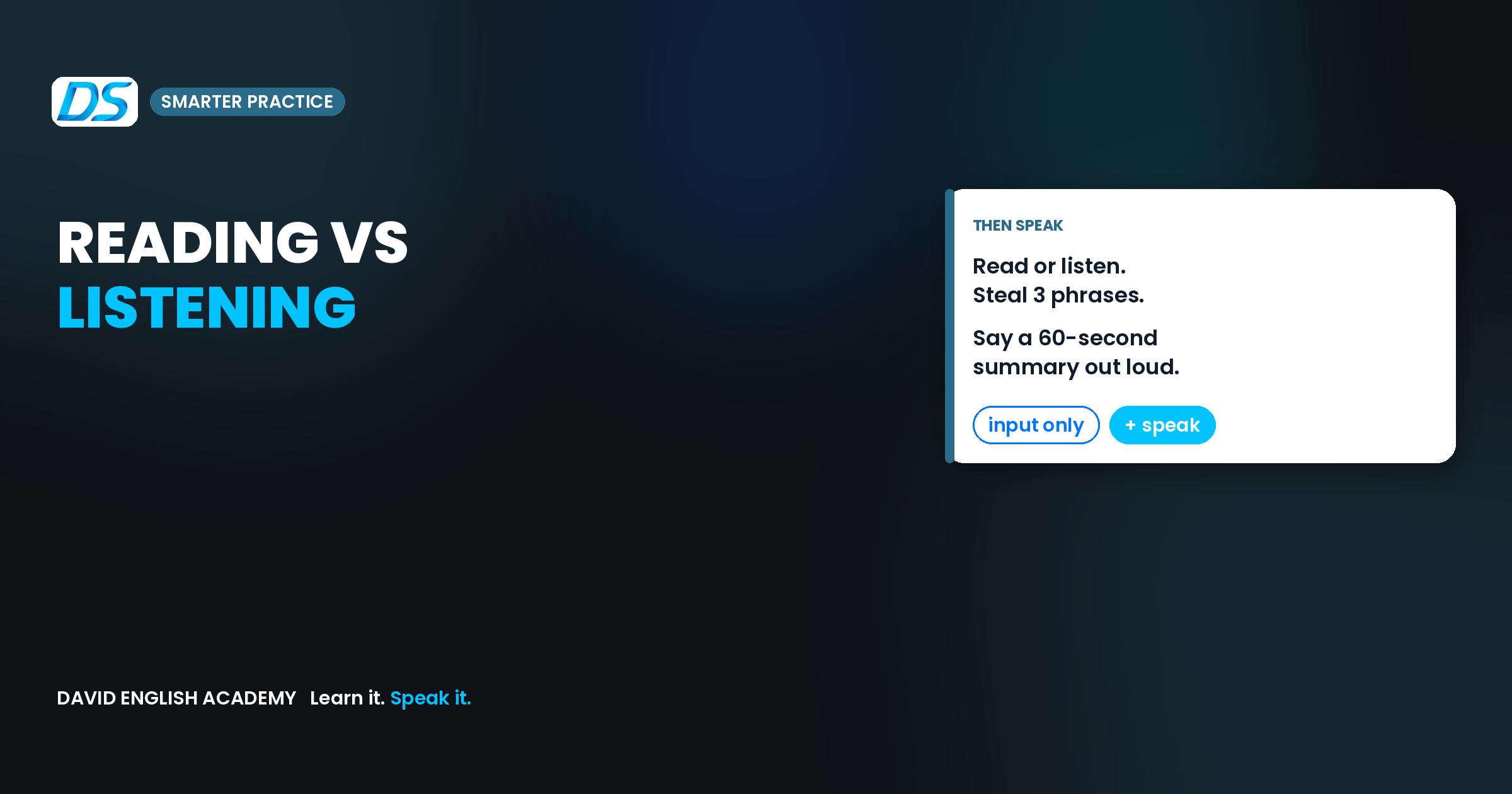
If your goal is to speak English more confidently, you've probably asked: should I read more, or listen more?
Short answer: both help — but neither replaces speaking. Reading builds the language in your head. Listening trains your ear for real speed and rhythm. Speaking is a third skill, and it's the one that fails in meetings if you never practise it out loud.
What reading actually gives you
Reading is excellent for:
- Vocabulary in context (not random word lists)
- Seeing how sentences are built
- Noticing useful phrases you'll later want to say
When you read "We need to take several factors into account," you learn the chunk take something into account — not just the word factor.
What reading does not do by itself: teach you how fast English sounds on a Zoom call, or force you to produce a sentence when four people are waiting.
What listening actually gives you
Listening trains:
- Speed and connected speech ("gonna", reduced vowels, interruptions)
- Intonation (where the important word lands)
- The feeling of real conversation, not textbook dialogue
What listening does not do by itself: make you speak. You can understand a whole podcast and still freeze when your manager asks, "What do you think?"
The trap I see with busy professionals
Many of my students are great at input. They read Slack in English. They watch series. They listen on the commute. Then in the meeting they go quiet — not because they didn't understand the question, but because production (choosing the word, then the form, under time pressure) was never trained.
So if you only have 20 minutes a day, don't spend all of it on more input. Split it.
| Goal | Better use of 20 minutes |
|---|---|
| Build vocabulary | 10 min reading + write 3 phrases you'll actually use |
| Train your ear | 10 min listening + shadow 5 sentences out loud |
| Stop freezing | 10 min timed speaking on a work prompt |
Choose the word, then say it (not just recognise it)
You read or hear: "Can we park that and come back to it?"
Do you only understand it — or can you use it?
Situation: A meeting is going off-topic. You need to redirect politely.
Words: park / stop / kill
"Can we ___ that idea for now and finish the budget first?"
Answer: Can we park that idea… (Stop is blunt; kill is too strong for most workplaces.)
Understanding the phrase in a podcast is step one. Choosing it under pressure is step two.
How I teach reading and listening (so they feed speaking)
In my lessons, input is never the finish line. You speak from day one. We take a short text or a listening clip tied to your job — a status update, a client email, a product description — and you choose the word that fits the real situation, then the structure. I correct, coach and build. No robotic transformations with the tense already given in the heading.
We also use short timed speaking turns (the JAM method): about 60 seconds, feedback, then a cleaner second take. Reading and listening become fuel for that speaking turn, not a replacement for it.
Mini exercise: Read this once: "We're slightly behind schedule, but we can still deliver by Friday if we prioritise the API work." Close the page. Set 45 seconds. Say the same idea in your own words, as if updating your manager on Zoom.
Your turn: After your next English email or Slack thread, take 60 seconds and summarise it out loud — what was asked, what you decided, what's next.
A simple weekly plan (busy-professional edition)
If you want a default without overthinking:
- 3 days: 10 minutes reading (work email, article, or docs) + 5 minutes spoken summary
- 2 days: 10 minutes listening (podcast/YouTube) + 5 minutes spoken opinion
- Every day you have a meeting in English: 60 seconds beforehand — what you will say if someone asks for your update
That's enough to keep speaking alive without quitting your job to "study English."
Frequently asked questions
Is reading or listening better for speaking English?
Neither wins alone. Reading builds knowledge; listening builds recognition of real speech; speaking builds production. If you freeze in meetings, add speaking practice even if your reading and listening feel strong.
Can I improve speaking by only listening to podcasts?
You'll understand more, and your ear will get sharper. You still need to produce language under a little pressure — short timed answers about your own work — or the freeze stays.
How should busy adults balance the three skills?
A simple split: some input you enjoy, then a short spoken summary. Ten minutes of reading or listening plus five minutes of speaking beats an hour of silent study.
Read next
- Practical Steps to Think in English (Without Translating First)
- Podcasts for Better English: Listen So You Actually Speak
I'm David Sugarman, founder of David English Academy. Born and raised in New York, I've been teaching English since 2011, and today I teach professionals online around the world. Learn it. Speak it. Read more about me, or visit the homepage to explore the courses.