Practical Steps to Think in English (Without Translating First)
Stuck translating in your head? Six practical steps to start thinking in English — from naming objects to narrating your day out loud.
If you translate every sentence from your own language into English in your head, speaking will always feel slow. You'll second-guess every word. The conversation will move on without you.
Thinking in English isn't magic. It's a habit. And you can build it with small steps that fit a busy day.
The short answer
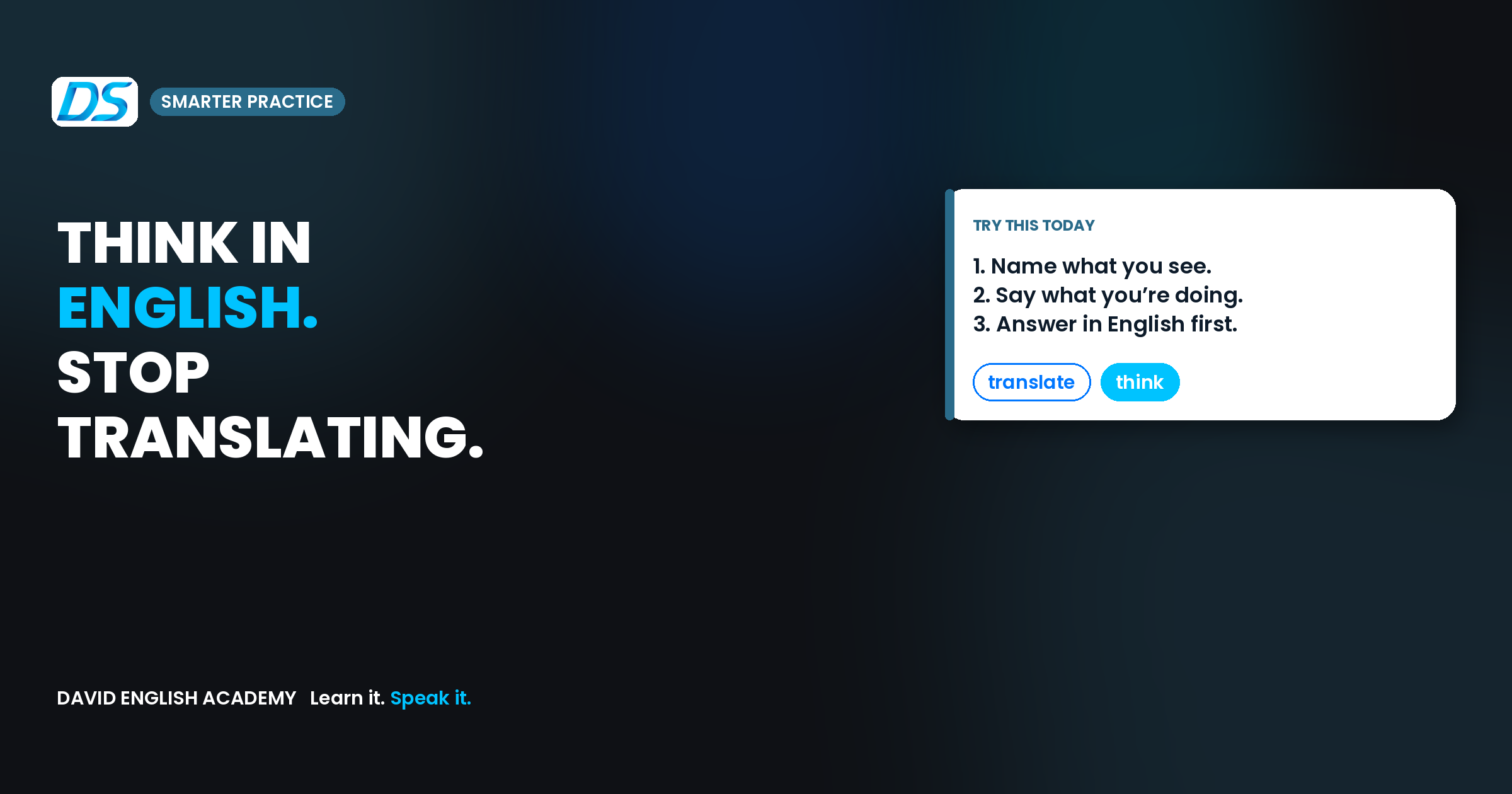
To think in English, stop translating full sentences. Start naming what you see, then narrating what you're doing, then answering simple questions in English first. Do it for a few minutes a day. The goal isn't perfect grammar. The goal is that English becomes the first language your brain reaches for in everyday moments, so you're not confused when someone asks you something at work.
Why translating slows you down
When you translate, you do the work twice:
- Think the idea in your language.
- Rebuild it in English.
Native speakers only do step 1, in English. You can't delete your first language, and you shouldn't try. You can train a shortcut: idea → English, for the situations you care about most.
My take: think in English about your life, not textbook life
A lot of advice says "think in English all day." That's not realistic if you live and work in another language. Here's what I ask students to do instead.
Think in English for the next thing you're about to say in English: the update, the email, the small talk before the meeting. Build the habit where it matters.
These six steps go from easy to harder. Do them in order. Keep each one feeling winnable.
1. Name everyday objects (1 minute)
Look around the room. In your head (or out loud), name what you see in English: chair, window, coffee, phone, laptop. No sentences yet. Just words.
If you don't know a word, look it up once, say it, and move on.
2. Narrate what you're doing (2 minutes)
Add a verb: "I'm drinking coffee. I'm opening my laptop. I'm walking to the kitchen." Use the present continuous. Keep it simple. Mistakes are fine.
3. Stop translating the easy stuff
When a simple idea appears ("I'm hungry", "Where are my keys?"), try to find the English first. If your first language jumps in, gently switch: "OK — English: Where are my keys?"
4. Switch one device to English
Change your phone or computer language to English for a week. You'll see the same menus every day. That's free vocabulary, with no worksheet.
5. Talk to yourself about your day (3–5 minutes)
In the car or in the shower, answer out loud:
- What did I do today?
- What's one thing on my mind at work?
- What am I doing tomorrow?
Short answers. Full sentences. This is private, so the fear is low.
6. Accept mistakes while you're thinking
If you worry about grammar while you think, you'll go back to translating. Focus on keeping English moving. You can clean up the grammar later, especially in a lesson where we correct and coach you.
Mini lesson: choose the word, then the form
You're thinking in English about your morning. Choose the word, then the form. Say it out loud.
Level 1: At home
Words: make / take / check
"I usually ___ coffee, then I ___ my emails."
Answer: I usually make coffee, then I check my emails.
Level 2: On the way to work
Words: sit / think / worry
"While I'm on the train, I ___ about the meeting, and I try not to ___."
Answer: While I'm on the train, I think about the meeting, and I try not to worry.
Level 3: At your desk
Words: start / send / feel
"I ___ with the easy tasks. When I ___ the first email, I ___ more in control."
Answer: I start with the easy tasks. When I send the first email, I feel more in control.
Your turn
For the next three things you do today, say one English sentence in your head or out loud.
Example: "I'm locking the door." "I'm waiting for the elevator." "I'm opening Zoom."
Tonight, answer out loud: What did I do today, in five English sentences?
If you did that, you practised thinking in English. Not in theory. In your real day.
Try it the way we do it in my lessons
Thinking in English gets easier when you practise it the same way we do in class: speak from day one about your life and job, not textbook dialogues. I give you a situation — your commute, your morning, the five minutes before a call — and you choose the word that fits, then the form, without building a full sentence in another language first. I correct, coach and build from there.
We also use short timed turns (the JAM method): roughly 60 seconds of speaking, feedback on what blocked you, then a smoother second take. That clock stops the translate-then-speak loop. You're training idea → English, under a little pressure, with English you'll actually use in meetings and emails.
Mini exercise (now): Set a 60-second timer. Narrate your last hour in English out loud — what you did, what you're doing next, one thing on your mind at work. No pausing to translate. When time's up, repeat the work part in 30 seconds, cleaner.
Your turn: Without writing first, answer: What am I doing for the rest of today? Speak five full English sentences.
Frequently asked questions
How long does it take to think in English?
You'll feel small wins in days if you practise a few minutes daily. Thinking in English for complex work topics takes longer. Start with easy moments, then move to work situations.
Should I force myself to think in English all day?
No. That's exhausting and you'll quit. Choose specific moments: your morning routine, your commute, the five minutes before a call.
What if I don't know a word?
Skip it or look it up once, say it, and continue. Don't stop the whole thought to translate a full sentence.
Read next
- Reading vs. Listening: What Actually Helps You Speak English Better?
- Podcasts for Better English: Listen So You Actually Speak
I'm David Sugarman, founder of David English Academy. Born and raised in New York, I've been teaching English since 2011, and today I teach professionals online around the world. Learn it. Speak it. Read more about me, or visit the homepage to explore the courses.