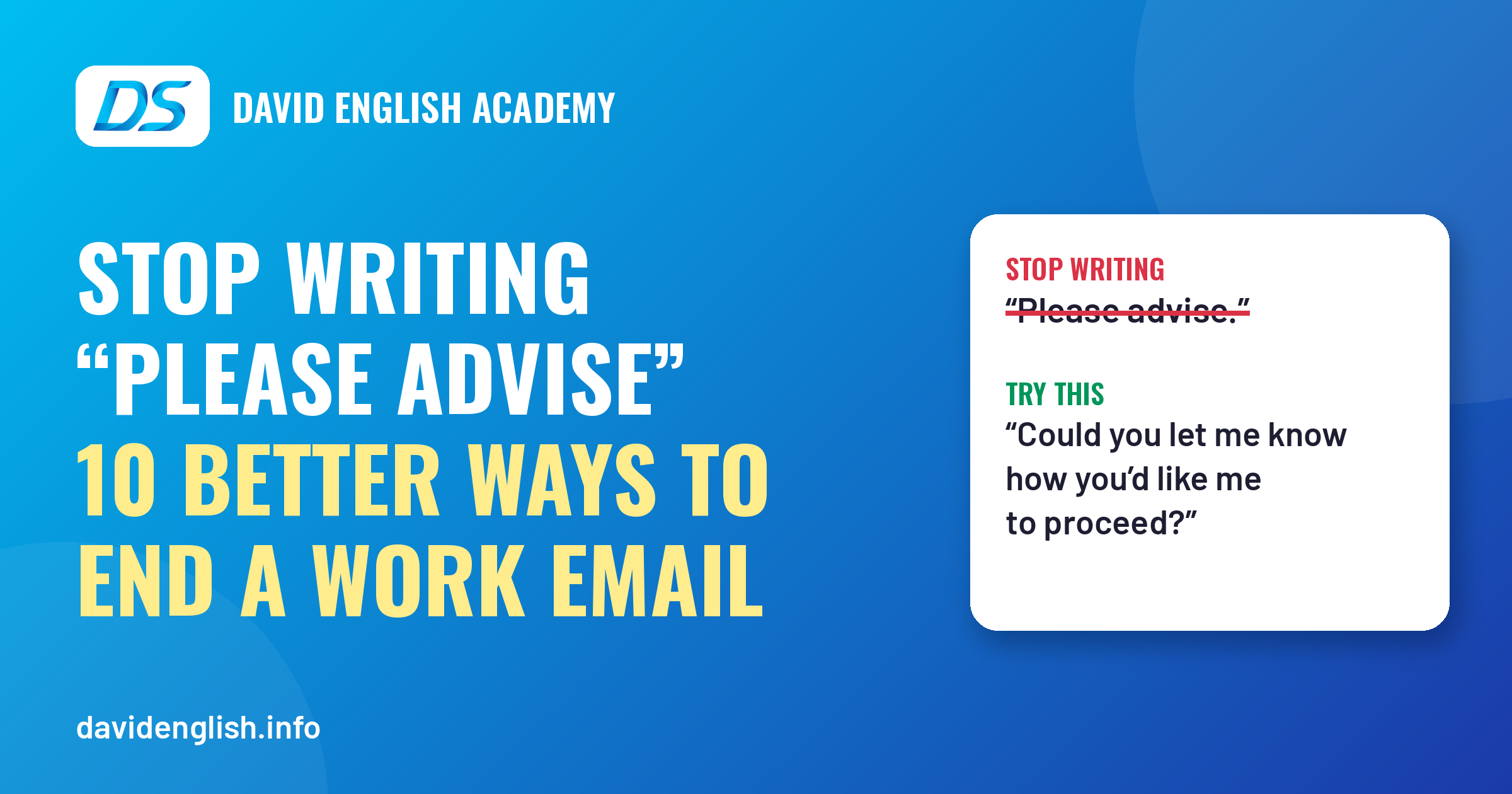
Stop Writing "Please Advise": 10 Better Ways to End a Work Email
"Please advise" sounds cold and old-fashioned. Here are 10 clearer, friendlier ways to end a work email in English, plus how to use them when you speak.
Open your sent folder and search for two words: please advise.
If you work in an international company, I'd guess you'll find them. Maybe a lot. It's one of the most common email endings I see from professionals who write in English as a second language, and one of the first ones I ask them to change.
There's nothing grammatically wrong with "Please advise." The problem is how it feels to the person reading it.
What's wrong with "Please advise"?
Three things:
- It sounds cold. Two words, no greeting, no context. To many native speakers it reads like an order, or a little passive-aggressive: "Your move."
- It's vague. Advise on what? Do you need a decision, a document, a date, or approval? The reader has to work it out.
- It sounds old-fashioned. It belongs to formal letters from decades ago. Modern business English is shorter, clearer and warmer.
The fix is simple: say exactly what you need, and ask for it politely.
10 better ways to end a work email
When you need a decision
- "Could you let me know how you'd like me to proceed?" — my go-to replacement. Polite, clear, professional.
- "Which option would you prefer, A or B?" — giving choices gets faster answers.
- "Let me know if you're happy for me to go ahead." — perfect when you only need a yes.
When you need information
- "Could you send me the updated figures by Thursday?" — a specific request with a deadline.
- "Could you confirm the delivery date when you have a moment?" — "when you have a moment" softens it without losing the request.
- "Do you have any thoughts on this?" — for feedback, not instructions.
When you're not sure what to do
- "I'd appreciate your guidance on the next steps." — formal but warm. Good for senior people and clients.
- "What would you suggest?" — short, direct and respectful.
When it's urgent
- "Could you get back to me by end of day, please? We need to confirm with the client tomorrow." — the reason makes the deadline feel fair, not pushy.
When you just want to stay open
- "Happy to discuss if anything's unclear." — closes the email with an invitation instead of a demand.
Before and after
Before: The supplier has increased the price by 8%. Please advise.
After: The supplier has increased the price by 8%. Should we accept it, or would you like me to ask for a quote from the second supplier? Could you let me know by Wednesday?
The second version is longer, but your manager can answer it in ten seconds. That's the goal.
The part nobody tells you: say it, don't just type it
Here's what I see in my lessons. People can write a perfect email, with AI help or without it. Then the same manager calls them, or asks the question in a meeting, and suddenly the words aren't there. They fall back on "So... what do you want me to do?"
That's because writing and speaking use the same phrases, but you've only practised one of them. A phrase you've only typed is still a phrase you know. A phrase you've said out loud is a phrase you can use.
Every one of the phrases above works in a meeting or on a call:
- "Could you let me know how you'd like me to proceed?"
- "Which option would you prefer?"
- "What would you suggest?"
So when you learn a new email phrase, practise it in your voice too.
Your turn
Choose three phrases from the list. For each one:
- Make it yours. Put in a real project, a real colleague, a real deadline.
- Say it out loud three times. Then once more, faster, as if you're on a call.
- Use it this week. Once in an email, once in a meeting.
Then answer this out loud: Your manager asks for your opinion on a new supplier, and you need more information before you decide. What do you say?
If you said something like "I'd like to check a few things first. Could you send me their price list?", you've got it.
Frequently asked questions
Is "Please advise" rude?
It isn't technically rude, but many readers find it cold, vague or demanding, especially as a one-line ending. A specific, polite question works better almost every time.
What can I say instead of "Please advise"?
"Could you let me know how you'd like me to proceed?" is the most direct replacement. If you need something specific, ask for it: "Could you confirm the date by Thursday?"
How do I end a work email professionally in English?
Finish with one clear request or next step, then a short closing like "Thanks," or "Best regards," and your name. Avoid ending with a vague phrase the reader has to interpret.
Can I use AI to write my work emails?
Yes, it can help. But don't let it be the only place you practise. If you can't say the phrase in a meeting, you haven't learned it yet.
Practise it out loud with JAM
Want to hear how professional you sound when you ask for a decision? Try JAM, my 60-second speaking challenge. You speak for one minute and get instant AI feedback on your fluency, grammar and vocabulary.
Try this prompt: "Explain a problem at work and ask your manager how to proceed."