You Know English Grammar. So Why Can't You Use It?
Know the grammar rules but freeze when you speak? Here's why, and how choosing the word, then the form, helps you actually use English at work.
Here's a conversation I've had many times with new students.
I ask, "How long have you worked at your company?"
They answer, "I work here five years."
Then I ask them to explain the present perfect, and they can do it perfectly. Form, rules, even the exceptions. They learned it in school. They passed tests on it. They just can't use it when someone asks them a real question.
If that sounds like you, nothing is wrong with your brain. You were trained to know grammar, not to use it. Those are two different skills, and in my lessons, the second one is the one we practise. Real progress is using the grammar in real conversations, until people understand you and you feel in control.
Why knowing grammar isn't the same as using it
Think about how most of us learned grammar at school. You get a worksheet. The top says "Present Perfect." Every sentence has a verb in brackets:
She ___ (visit) London twice.
You don't have to think about the situation at all. The page already told you which tense to use. You just change the verb, write "has visited," and move on. It's like a robot on an assembly line: take the word, transform it, next.
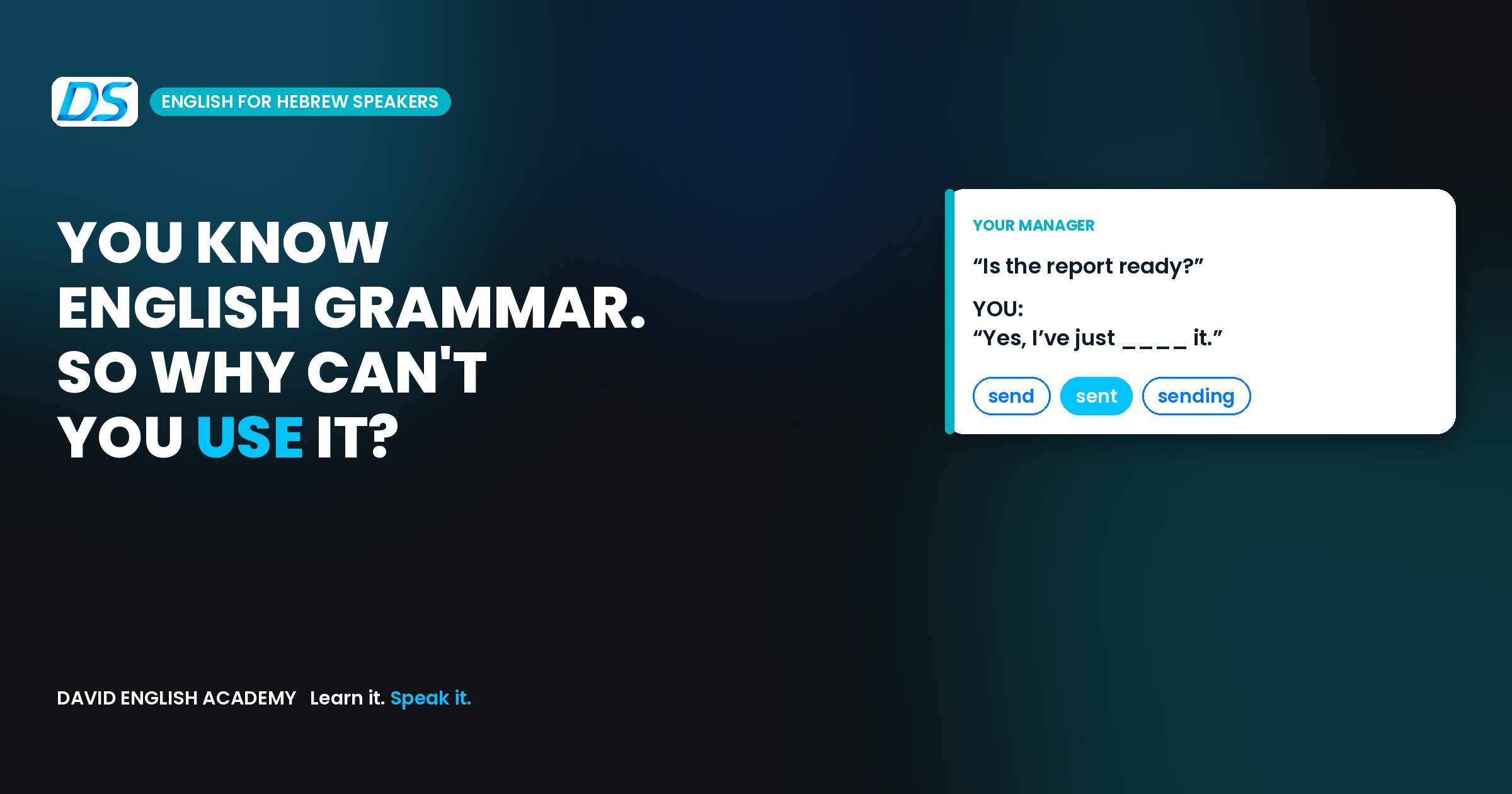
Real life never gives you the heading. Your manager doesn't say, "Present perfect question coming. Ready?" She just says, "Is the report ready?" and in about two seconds you have to decide:
- What do I want to say? (Yes, I finished it a few minutes ago.)
- Which word fits? (Finish? Send? Upload?)
- Which form fits the situation? (I've just sent it, not I sent it just.)
Those worksheets trained step 3 by itself, with steps 1 and 2 taken away. So when a real conversation asks you for all three at once, you freeze, or you fall back on the simplest form you have: "I work here five years."
The extra challenge for Hebrew speakers in high-tech
Many of my students are Hebrew speakers working in high-tech, and there's a specific reason some present-perfect mistakes stick around.
Hebrew doesn't have a present perfect. In Hebrew, "I've lived here for five years" is simply "אני גר פה חמש שנים", which is literally "I live here five years." So when you speak quickly in a meeting or on a Zoom call, your brain grabs the Hebrew structure and fills it with English words. Other languages have a similar pattern; this post focuses on the Hebrew one I hear most often.
That's why you hear (and maybe say):
- "I work here since 2019." → I've worked here since 2019.
- "I am waiting for his answer two weeks." → I've been waiting for his answer for two weeks.
None of these will stop a meeting. People will understand you. But they're exactly the moments when an engineer or a manager who knows they understand English feels, "My English sounds less professional than I am." And knowing the rule doesn't fix it. Using the rule, again and again, in situations that feel real, does.
How I teach it instead: "use it, don't just know it"
When I build a lesson, I have a few simple rules for myself.
1. Every exercise makes you choose
I don't give you the verb in brackets and the tense in the heading. I give you a situation and a few possible words. You decide which word fits, and then which form. That's the same thinking you need on a Zoom call. It feels harder than a worksheet at first, and that's the point.
2. Easy first, then harder
We start with situations you already know, like your weekend, your family, your morning, and then we move to work: meetings, emails, clients, colleagues. Each step is a little more demanding, but never so hard that you want to close the laptop. I want you to finish every lesson feeling, "I can do this."
3. Situations from your real day
Small talk at the coffee machine. Updating your manager. Answering a client email. Explaining a delay without sounding defensive. If you'll never actually say the sentence, we don't practise it.
4. It's short and you can win
My students are busy people. Lessons are short videos with practice you can finish in one sitting, and the goal of each one is clear.
5. Every lesson ends with "Your turn"
The last part of every lesson is a question about you: your opinion, your work, your week. You answer it out loud. That's where knowing becomes using.
6. Short timed speaking turns (the JAM idea)
Knowing the rule in your head is not the same as using it under a clock. In lessons — and in my JAM speaking practice — you get a real work prompt, speak for about 60 seconds, then we correct, coach and build the next attempt. No robotic transformations. You choose the word that fits the situation, then the form, while someone is listening. That pressure is what turns "I know present perfect" into "I've worked here for five years" on a Zoom call.
Try this now (60 seconds): Set a timer. Answer out loud: How long have you been in your current role, and what's one project you've been working on lately? When the timer stops, say the same answer once more — clearer, with the present perfect where it belongs.
Your turn: Record that second take on your phone. Listen once. Did you choose the right forms without translating first?
A mini lesson: choose the word, then the form
Let's try it. For each situation, pick the word that fits, then put it in the right form. Say your answer out loud before you look.
Level 1: Your manager at 10:00
Your manager stops by your desk: "Is the report ready?"
Words: finish / send / forget
You emailed it to her five minutes ago.
"Yes, I've just ___ it to you."
Answer: I've just sent it to you. (Send, because it went to her inbox. Present perfect with just, because it happened a moment ago and it matters now. She should check her email.)
Now change one detail: you emailed it yesterday afternoon. What changes?
Answer: Yes, I sent it to you yesterday afternoon. Once you name a finished time, you go back to the past simple.
Level 2: A client email
A client writes: "Any update on the new design?"
Words: work / deliver / wait
Your team started on Monday and will finish on Thursday.
"Hi Dana, we ___ on it since Monday, and we ___ the final version by Thursday."
Answer: We've been working on it since Monday, and we'll deliver the final version by Thursday.
Notice what happened. Two situations, and each time you had to think first: what happened, when, and does it matter now? That thinking is the skill. The form is the last step, not the first.
Your turn
Answer these out loud, in full sentences:
What's one thing you've finished this week that you're proud of? And what's one thing you've been working on that's taking longer than you expected?
If you used I've finished and I've been working without stopping to think, you're already using it, not just knowing it.
Frequently asked questions
Why do I know English grammar but can't use it when I speak?
Usually because you practised grammar as a transformation exercise. The tense was given and you only changed the verb. Speaking asks you to choose the meaning, the word and the form at the same time, in real time. That's a separate skill, and it gets better when you practise choosing in realistic situations.
What's the best way to practise English grammar for speaking?
Use short exercises built around real situations: choose which word and which form fit, then say the answer out loud. Start with everyday topics, then move to meetings and emails.
Why do Hebrew speakers say "I work here five years"?
Hebrew has no present perfect tense, so the Hebrew sentence structure ("I live here five years") often moves directly into English. Practising the present perfect in real questions about your own work — "How long have you been in this role?" — helps it become automatic in meetings.
Read next
- I Understand English but Can't Speak It. Why, and How to Fix It
- Scared of Speaking English? What to Do When You Freeze
I'm David Sugarman, founder of David English Academy. Born and raised in New York, I've been teaching English since 2011. I work with Hebrew speakers in high-tech who want clear, confident English for meetings, emails and interviews. Learn it. Speak it. Visit the homepage, read more about me, or get in touch about one-on-one coaching.