Is English Bad for You? My Take in the Age of AI Translation
Is English bad for you — or is learning it the wrong way the real problem? My take on culture, AI translation, and why speaking still matters at work.
Every few months someone tells me English is "bad for you." Bad for your culture. Bad for your first language. Bad for your brain. And lately, with real-time AI translation in Zoom and Teams, a quieter version of the same idea: maybe you don't need English at all.
I get why people say it. English is powerful, and powerful languages can feel unfair. But here's my honest answer as a teacher: English isn't bad for you. Learning English the wrong way is. Dropping your first language, chasing perfect grammar on worksheets, or letting an app replace speaking — that can hurt. Using English at work while keeping your own language and identity? That opens doors.
What people really mean when they say "English is bad for you"
Usually they mean one of three things.
- English is pushing out other languages. That's a real cultural worry, and it's bigger than any English lesson.
- People feel stupid in English. Freezing on Zoom doesn't feel like progress. It feels like damage.
- AI can translate now, so why bother? If software can carry your voice into another language in a meeting, why spend months practising?
I take all three seriously. None of them means "stop explaining your work clearly to an international client."
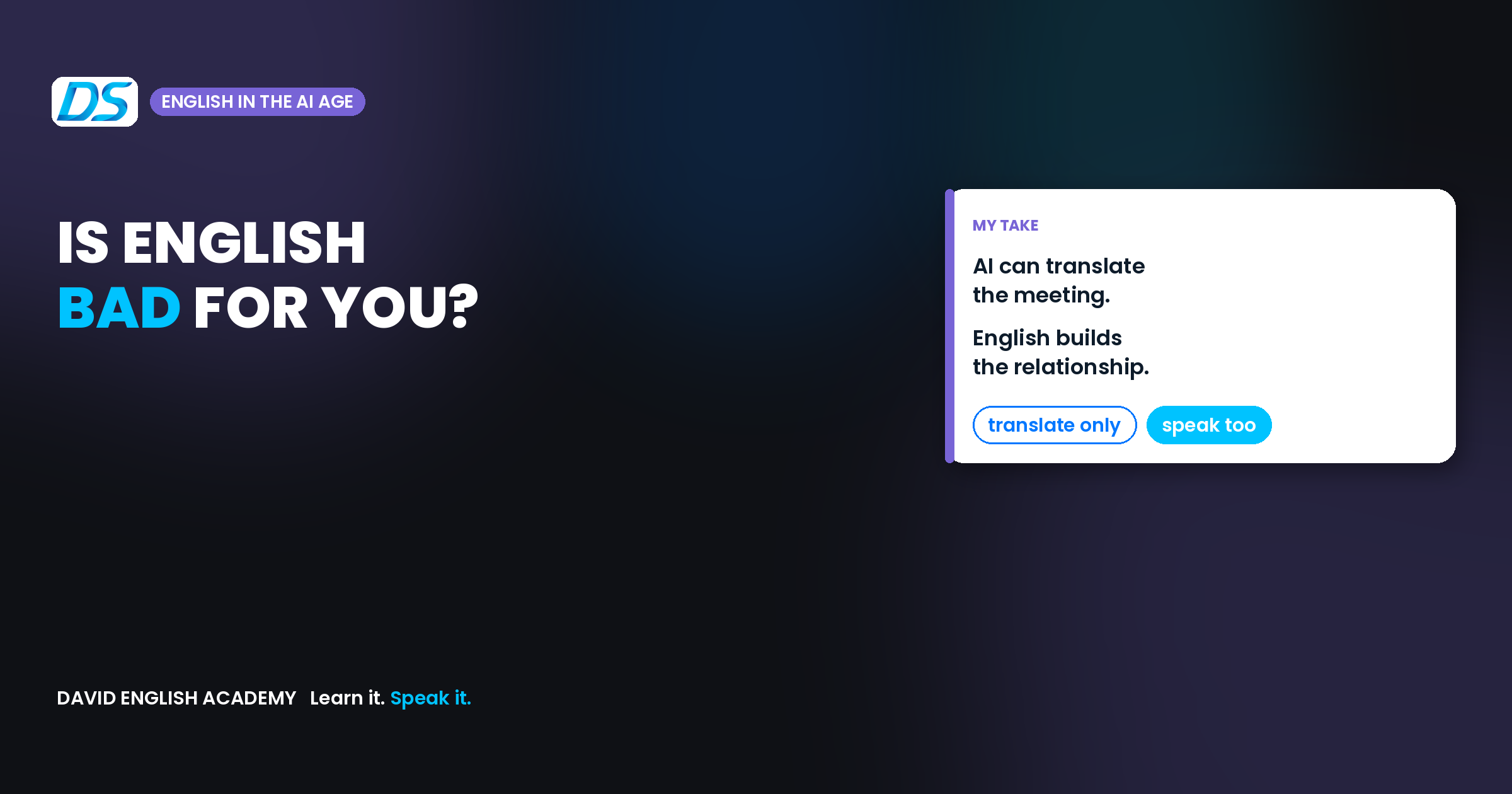
AI can translate the meeting. It can't build the relationship.
In September 2026, DeepL announced upgrades to DeepL Voice: real-time voice translation for Zoom, Microsoft Teams and Google Meet, with more of the speaker's tone and expression kept across languages (PR Newswire, 15 Sep 2026). That's impressive technology. I've told students to use translation tools for drafts and for catching up when they're lost.
Here's where I push back. Translation gets you through the meeting. English gets you the relationship: the small talk before the agenda, the joke that softens a hard message, the trust that makes someone take your call next week. When every word goes through a machine, people hear content. They don't feel you.
If your career depends on clients, partners or a global team, English isn't a fashion. It's how you show up.
English isn't the enemy of your first language
I work with professionals who speak Hebrew, Arabic, Spanish, French, Russian and more. The ones who improve fastest don't "replace" their first language. They add English for work — meetings, emails, interviews — and keep their own language for home, humour and identity.
What is bad for you:
- Studying English until you hate speaking
- Copying AI emails that don't sound like you
- Believing one more grammar book will fix a freeze on camera
What helps:
- Speak from day one, even if it's messy
- Practise the English of your real job
- Keep your first language strong — bilingual brains aren't a problem; unused speaking practice is
A mini lesson: say what translation can't say for you
You're in a Zoom call. The AI captions are fine. Now you need to sound human.
Situation 1: Soften bad news
Words: delay / push / miss
The feature won't ship this week. You still want the client to trust you.
"We're going to ___ the release by one week, but I'll send a clear plan today."
Answer: We're going to push the release by one week… (Delay is also fine; miss sounds like failure without a plan.)
Situation 2: Build the relationship in 10 seconds
Before the agenda: "How was your weekend?" feels empty if you always say "Fine." Practise one real line:
"Pretty good — I finally finished a long hike. How about you?"
That's the English translation tools rarely invent for you: small, specific, human.
Keep your first language on purpose
If you're worried English is "erasing" you, make a simple rule at home and at work:
- Work blocks: English for the international channel (Zoom, client email, docs)
- Identity blocks: your first language for family, humour, culture, and thinking that doesn't need English
You're not choosing a winner. You're choosing the right tool for the moment.
How I teach this
When a student arrives convinced "English is the problem," we don't argue about culture for an hour. We open a real work situation and speak.
You choose the word that fits the situation, then the form and structure — no robotic worksheet transformations. I correct, coach and build, lesson by lesson. We use short timed speaking turns (the JAM method): about 60 seconds on a prompt, feedback, then a cleaner second take. That's how "I need English for my career" becomes something you can actually do on Monday.
Mini exercise (60 seconds): Set a timer. Answer out loud: What's one thing English has already helped you do at work — and one thing you still avoid saying in English? When the timer stops, say the second part again, clearer, in three sentences.
Your turn: Without notes, tell a colleague (or your phone) why you're learning English this year — in English.
Frequently asked questions
Is English bad for my native language?
Only if you abandon your native language. You can — and should — keep both. Use English for the situations that need it, and keep your first language active at home and with friends.
Do I still need English if AI can translate meetings?
For basic information transfer, tools help. For trust, humour, leadership and interviews, people still respond to you. Translation is a support, not a substitute for speaking when the stakes are high.
What's the healthiest way to learn English as an adult?
Short, regular speaking practice tied to your real job. Correct the mistakes that block understanding. Don't punish yourself for an accent. Don't drop the language that makes you you.
Read next
- ChatGPT vs Real Conversation: How to Use AI Without Killing Your Speaking
- How to Learn English Effectively When You're Busy
I'm David Sugarman, founder of David English Academy. Born and raised in New York, I've been teaching English since 2011, and today I teach professionals online around the world. Learn it. Speak it. Read more about me, or visit the homepage to explore the courses.