ChatGPT vs Real Conversation: How to Use AI Without Killing Your Speaking
Can ChatGPT replace real conversation practice? A 2026 study plus my take: use AI as the gym, people as the match.
ChatGPT can talk to you at 2 a.m. It never gets tired. It never judges your accent. So of course students ask me: "David, can I just practise with AI and skip the awkward Zoom calls?"
My short answer: use AI, but don't let it replace real conversation. Used well, it makes you faster. Used alone, it can leave you fluent with a bot and frozen with a person.
The short answer
ChatGPT is excellent for preparing, practising and polishing English. It is weaker at the parts of speaking that happen with real people: interruptions, half-finished thoughts, body language, and the feeling that someone is waiting for your answer. Use AI to get ready. Use real conversation (or a teacher) to get strong.
What a real study found (August 2026)
In August 2026, researchers published a study in the Asian-Pacific Journal of Second and Foreign Language Education on ChatGPT-assisted speaking practice. Intermediate English learners practised for ten weeks. The group that used structured ChatGPT speaking practice improved more in fluency (they spoke faster and produced longer, richer sentences) than the group with only teacher-led practice. Accuracy improved in both groups in a similar way. In other words: AI helped them talk more. It did not clearly make them more correct than a teacher did.
Source (open access): Enhancing EFL learners' speaking performance through ChatGPT-assisted practice (Karami, Feizarbabi & Xodabande, published 6 August 2026).
That matches what I see in lessons. Students who chat with AI get braver and faster. The same students still need a human to catch the mistakes they keep repeating, and to practise the messy, real situations at work.
My take: AI for the gym, people for the match
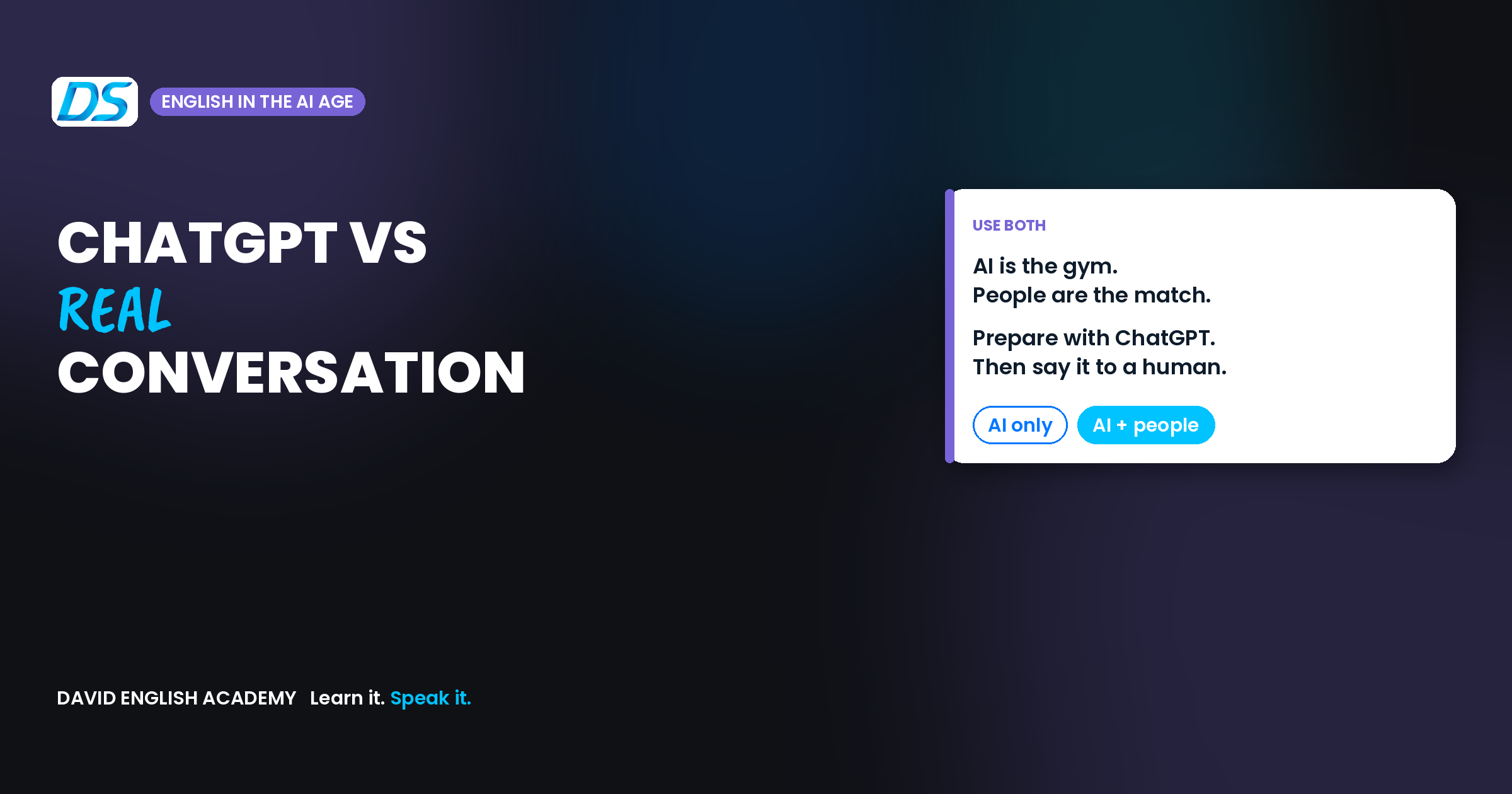
Think of ChatGPT as the gym. Real conversation is the match.
At the gym you can repeat, pause, try again. Nobody is watching. In the match, someone interrupts you. The topic changes. You have to smile and keep going. Both matter. If you only go to the gym, you never learn the match. If you only play the match with no training, you freeze.
Here's how I tell students to use both.
Do this with ChatGPT
- Prepare before a meeting. "I'm meeting a US client about a delayed shipment. Ask me five questions they might ask, one by one."
- Role-play the awkward part. "You are my manager. Ask me why the report is late. Push me a little."
- Polish one email. Paste your draft and ask: "Make this clearer and more polite, but keep my meaning. Explain every change in one line."
- Drill one mistake. "I keep saying 'I work here five years.' Give me ten short questions that force me to use the present perfect about my job."
Don't do only this with ChatGPT
- Don't let it write every email for you, so you never practise writing.
- Don't only type. Typing is safer than speaking. Switch to voice mode, or read your answers out loud.
- Don't accept every "perfect" sentence. If you wouldn't say it, don't learn it. Ask: "Make this sound like something a normal person would say in a meeting."
A simple weekly routine (busy-person version)
| Day | 10 minutes |
|---|---|
| Mon | ChatGPT: role-play tomorrow's update. Then say your answers out loud twice. |
| Tue | Real: speak English in one low-stakes moment (a colleague, a voice note, a lesson). |
| Wed | ChatGPT: rewrite one work email. Send a version that still sounds like you. |
| Thu | Real: join a call and say something in the first five minutes. |
| Fri | ChatGPT: "What mistakes did I make in this paragraph?" Fix one pattern only. |
That's enough. No more generic apps. Just real progress, a little every day.
Mini lesson: choose the word, then the form
You're preparing with AI, then you'll say it to a person. Practise out loud.
Level 1: Asking ChatGPT for practice
Words: ask / give / make
"Please ___ me five questions about my project, and ___ me time to answer each one."
Answer: Please ask me five questions about my project, and give me time to answer each one.
Level 2: In the real meeting
Your client asks: "Why is this late?"
Words: hit / need / move
"We ___ a delay with the supplier. We ___ two more days, and then we can ___ forward."
Answer: We hit a delay with the supplier. We need two more days, and then we can move forward.
Level 3: After the call (with AI)
Words: sound / keep / change
"Please improve this update. ___ my meaning, and tell me every ___ you ___."
Answer: Please improve this update. Keep my meaning, and tell me every change you make.
Your turn
Do this now, out loud (you can use ChatGPT after, not before):
Explain a small problem at work to an imaginary colleague. What happened? What do you need? When will it be fixed? Speak for 45–60 seconds.
Then, if you want, paste a written version into ChatGPT and ask what to improve. Say the improved version out loud once more.
How I teach this with AI in the mix
AI is welcome in my method — as the gym, not the match. In lessons you still speak from day one about real work: meetings, Zoom calls, emails. You choose the word that fits the situation, then the form and structure. I correct, coach and build the patterns you keep repeating. ChatGPT can drill those patterns; it can't replace a human catching avoidance or coaching you through the feeling of someone waiting for your answer.
We use short timed speaking turns (the JAM method): about 60 seconds on a prompt, feedback, then a cleaner second take. Use AI before that turn to warm up, or after to polish one phrase — but say the final version out loud yourself.
Mini exercise (right now): Before opening ChatGPT, set a 60-second timer. Explain a small work delay out loud: what happened, what you need, when it'll be fixed. Then, if you want, ask AI for one clearer version. Say your improved answer once more in 45 seconds.
Your turn: Without typing first, speak for 60 seconds: How will you use AI this week without letting it replace real conversation?
Frequently asked questions
Can ChatGPT replace an English teacher?
No. It can give you endless practice and ideas. A teacher (or a real conversation partner) catches your repeated mistakes, pushes you when you avoid hard topics, and coaches you through the emotions of speaking. Use both.
Should I use ChatGPT voice mode or typing?
Prefer voice when you can. Typing lets you edit forever. Speaking trains the skill you need in meetings.
Is AI-written English OK at work?
For a first draft, yes. For the final message, make sure it still sounds like you. People notice when every email suddenly sounds like a robot. Clear and human beats perfect and fake.
Read next
- Is English Bad for You? My Take in the Age of AI Translation
- How to Learn English Effectively in 2026 (When You're Busy)
I'm David Sugarman, founder of David English Academy. Born and raised in New York, I've been teaching English since 2011, and today I teach professionals online around the world. Learn it. Speak it. Read more about me, or visit the homepage to explore the courses.