Business Vocabulary for Electrical Engineering Teams
Scope, milestones, mitigation, sign-off — the business English electrical engineering teams need for clients and Zoom updates, with a speaking drill included.
If your engineers can design the system but freeze when a client asks for a status update in English, you don't have a "vocabulary app" problem. You have a speaking-at-work problem.
Short answer: electrical engineering teams need business English for scope, risk, milestones, compliance and clear client updates — practised out loud, not memorised from flashcards.
Why this matters for engineering managers
Technical skill gets the project built. English decides whether:
- A client trusts your timeline
- A partner understands a risk early
- Your engineer can defend a design choice on Zoom
- HR can move people into international roles
I've coached professionals in technical fields where the English gap wasn't equations — it was the meeting after the equations.
Core business vocabulary your team will actually use
Skip random word lists. Start with language tied to delivery.
Project language
- Scope — what is included / excluded
"That's out of scope for this phase." - Milestone — a checkpoint that matters
"We hit the design-freeze milestone on Monday." - Deliverable — what you hand over
"The deliverable is the revised single-line diagram." - Dependency — what you're waiting on
"We're blocked on a vendor dependency."
Risk and status language
- On track / at risk / delayed
- Root cause — why it happened
- Mitigation — what you're doing about it
- Workaround — temporary path while you fix the real issue
Stakeholder language
- Stakeholder — anyone with a real interest in the outcome
- Sign-off — formal approval
- Alignment — shared understanding before you proceed
- Trade-off — what you gain vs what you give up
Engineering-in-business language
- Prototype / pilot
- Compliance — meeting the required standard
- Spec (specification)
- Tolerance / margin
- Commissioning — bringing the system into operation
Mini lesson: choose the word, then the form
Situation: A client asks why testing slipped.
Words: delay / postpone / cancel
"We had to ___ the factory acceptance test by five days because the firmware build failed validation."
Answer: postpone (or delay). Cancel is wrong unless the test is off entirely.
Now say the full answer out loud, then add one mitigation sentence: "We've added an extra validation gate so it doesn't happen again."
Phrases for the client call (steal these)
- "Here's where we are against the milestone."
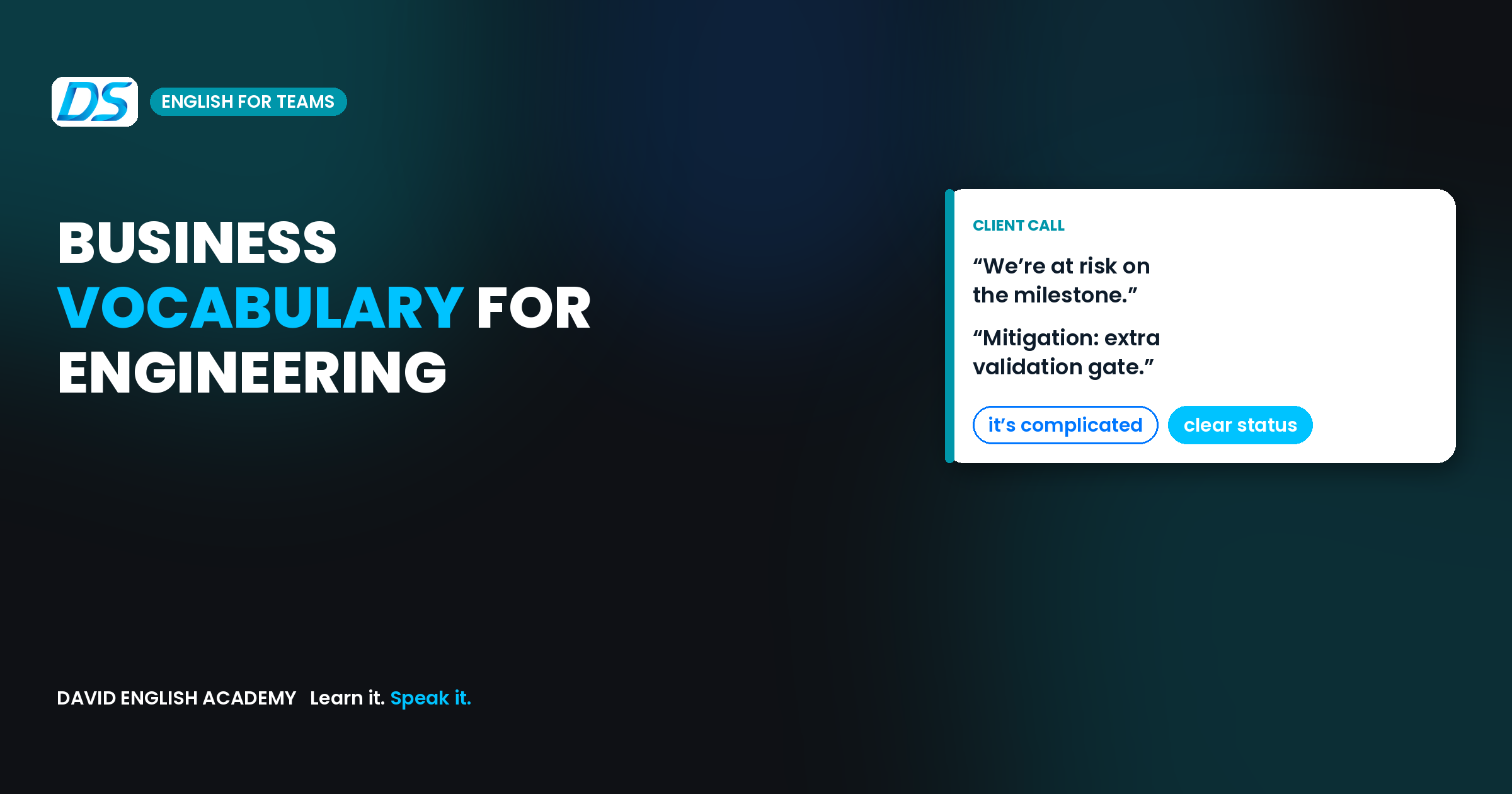
- "The main risk is X; the mitigation is Y."
- "That request is possible, but it changes scope and timeline."
- "I need a decision on Z by Thursday to stay on track."
- "Let me rephrase that more simply…" (powerful when the room is lost)
Practise them with your project nouns — breakers, firmware, load, voltage, panels — so the language and the tech travel together.
How I teach engineering teams
Team training works when it uses the English of your real projects. People speak from day one. They choose the word that fits the situation, then the structure — no robotic worksheet transformations. I correct, coach and build. Short timed speaking turns (the JAM method) train a 60-second update that a client can follow.
For managers and HR: this is exactly the kind of practical language we drill in corporate programs — including intensive one-on-one schedules when a team needs to be ready fast.
Mini exercise for an engineer (60 seconds): Explain your current project: goal, where you are, one risk, one ask. Record it. Listen once. Cut anything a non-engineer client wouldn't need.
Your turn: In your next standup, use one precise status phrase (at risk, dependency, mitigation) instead of "it's complicated."
Frequently asked questions
Do engineers need business English or only technical English?
Both. Technical English describes the system. Business English explains status, risk, cost and decisions to people who don't share your specialty.
What's the fastest way to improve meeting English for an engineering team?
Practise the real updates: short timed turns, feedback, then a cleaner second take. Vocabulary lists help only when they're tied to those updates.
Can we train the whole team together?
Group workshops help for shared phrases. One-on-one time fixes each person's repeated blockers faster. Many companies use a mix.
Read next
- How to Measure Your Team's English Progress (Without Fake Stats)
- Getting Your Team Ready for a Move Abroad
I'm David Sugarman, founder of David English Academy. Born and raised in New York, I've been teaching English since 2011, and today I teach professionals and teams online around the world. Learn it. Speak it. Read more about me, visit the homepage, or talk to David about training your team.