American Baseball Slang You'll Actually Hear at Work
Touch base, ballpark, home run — baseball slang shows up in meetings. Here's what the common phrases mean at work, from a New York teacher.
I grew up in New York, so baseball wasn't optional culture — it was background noise. What surprised me later, as a teacher, is how often baseball slang shows up in business English: meetings, Slack, emails, even performance reviews.
You don't need to love the sport. You need to recognise the phrases so you don't freeze when someone says, "Let's touch base" or "That was a home run."
Why baseball slang shows up at work
American business English borrows from sports the same way it borrows from tech. Short metaphors travel well. A few of them became so common that people use them without thinking about baseball at all.
Here are the ones I hear most with professionals — with a work example, not a stadium one.
Touch base
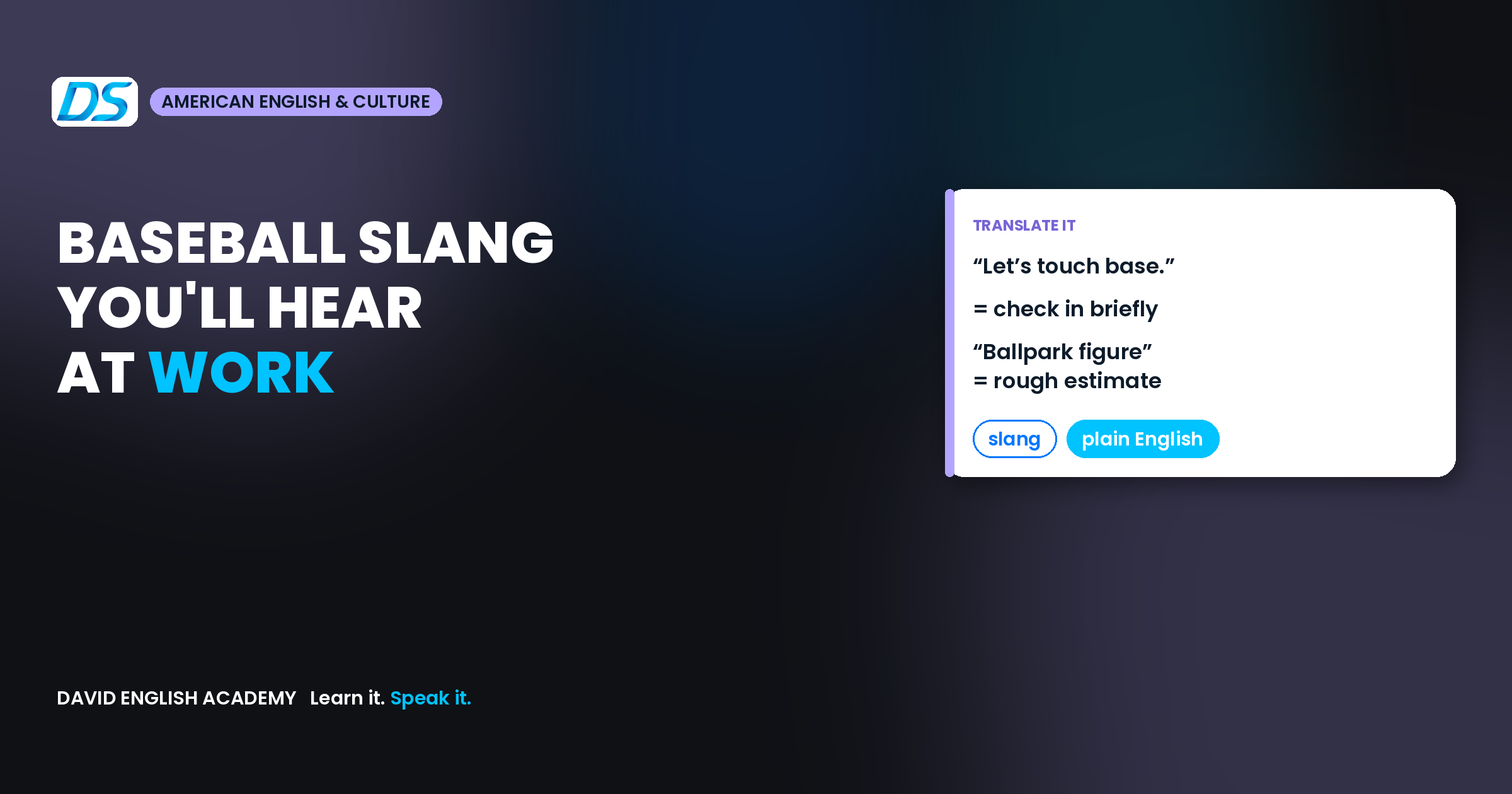
Meaning: Make brief contact; check in. At work: "Let's touch base tomorrow about the launch." Not romantic. Not about a base. Just "let's talk briefly."
Home run
Meaning: A clear success. At work: "Your demo was a home run with the client."
Strike out
Meaning: Fail completely at an attempt. At work: "We struck out with that pricing model — time to rethink."
Out of left field
Meaning: Unexpected; surprising. At work: "That question came out of left field."
Ballpark (figure)
Meaning: An approximate number. At work: "Can you give me a ballpark figure for Q3?"
Cover all the bases
Meaning: Handle every important detail. At work: "Before the audit, we need to cover all the bases."
Throw a curveball
Meaning: Present something unexpected and difficult. At work: "Legal threw us a curveball late yesterday."
In the ballpark
Meaning: Close enough; roughly correct. At work: "Your estimate is in the ballpark."
Step up to the plate
Meaning: Take responsibility; act when it's your turn. At work: "Someone needs to step up to the plate on this bug."
Rain check
Meaning: Postpone an offer politely. At work: "Can I take a rain check on lunch? Deadline day."
Do you need to use these yourself?
Not always. Understanding them matters more than forcing them into every sentence. If your team is international, a clear alternative often works better: check in, big success, rough estimate.
But if you work with American clients or US-based teams, recognising these phrases stops that half-second of panic: "Base? Plate? Are we still talking about the project?"
A quick "translate to plain English" drill
When you hear baseball slang and feel lost, you don't need a sports lecture. You need a plain equivalent.
| You hear | You can say / understand as |
|---|---|
| touch base | check in briefly |
| ballpark figure | rough estimate |
| home run | big success |
| curveball | unexpected problem |
| cover all the bases | handle every key detail |
| step up to the plate | take responsibility |
In international teams, I often coach people to understand the slang and reply in clear English. You still follow the meeting. You don't have to perform American culture.
How I teach culture phrases like these
I don't give students a list of 200 idioms to memorise. We pick the ones that appear in their meetings, then practise choosing the right one for the situation — and knowing when a plain phrase is better.
Speak from day one. Choose the word that fits the real situation, then the form. I correct, coach and build. Short timed speaking turns (the JAM method) put the phrase under a clock so it shows up when you need it, not only when you study it.
Mini exercise (60 seconds): Set a timer. Explain a recent project update using two of these: touch base, ballpark, curveball, home run. Then say the same update again with zero baseball slang — equally clear.
Your turn: Think of your last English meeting. Which baseball phrase did you hear — or which plain English phrase would have been clearer?
Frequently asked questions
Do I need baseball slang to sound fluent?
No. Clear, direct English is always enough. Baseball slang is useful for understanding Americans and optional for speaking.
What's the most common baseball phrase at work?
In my lessons: touch base and ballpark. You'll hear those even from people who never watch baseball.
Is it OK to ask what a phrase means in a meeting?
Yes. "Just to make sure I follow — when you say touch base, do you mean a quick call tomorrow?" sounds professional, not weak.
Read next
I'm David Sugarman, founder of David English Academy. Born and raised in New York, I've been teaching English since 2011, and today I teach professionals online around the world. Learn it. Speak it. Read more about me, or visit the homepage to explore the courses.