Your Airline Job Interview in English: Cabin Crew Prep That Actually Helps
Preparing for a cabin crew or airline interview in English? Build clear service stories, practise passenger phrases, and stay calm under pressure.
You've applied for a cabin crew job, or a ground role at an airline. Your service experience is strong. You love travel. You're good with people. Then the invitation arrives, and it says the interview is in English. Suddenly you're second-guessing every sentence before you've said a word.
I've helped many people prepare for interviews in English. Airline interviews have their own flavour, but the English you need is very learnable. Here's how I'd prepare you.
The short answer
For an airline or cabin crew interview in English, prepare short, clear stories about customer service, teamwork and staying calm under pressure, and practise saying them out loud. Interviewers want to understand you easily and trust you with passengers. They don't need perfect grammar. They need clear, warm, confident English, the kind people actually understand the first time.
What airline interviewers are listening for
Every airline is different, so always read the job ad carefully. But in any customer-facing role, the people interviewing you are usually listening for the same things:
- Clarity. Can passengers understand you, even in a noisy cabin?
- Calm. Do you stay polite and steady when something goes wrong?
- Teamwork. Do you talk about "we", and support colleagues?
- Service attitude. Do you sound like you genuinely enjoy helping people?
Notice that "native accent" isn't on that list. A clear, friendly voice and good structure matter far more.
Some employers now start with a video or AI interview before you meet a person. A September 2026 CNBC report on hiring technology describes how AI interviewers ask questions and send a summary to the hiring manager, and points out that they're often bad at asking follow-up questions. That means your first answer has to be complete. The advice below works for both a human and a bot.
Source: Your AI interviewer will see you now (CNBC, 16 September 2026).
My take: build an answer bank, then practise until it's easy
At David English Academy, interview prep is practical. We don't memorise a script, because scripts break the moment someone asks a follow-up question. We build an "answer bank" from your real experience, then you speak from day one. I correct, coach and build you up until you stop second-guessing and start sounding like yourself.
Use a simple story structure
For each story, prepare four short lines:
- Situation: Where were you, and what was happening?
- Task: What did you need to do?
- Action: What did you do? (Use "I", not only "we".)
- Result: What happened in the end?
Aim for about one minute per answer.
Questions to prepare for
General questions:
- Tell me about yourself.
- Why do you want to work for an airline? Why this airline?
- Tell me about a time you worked as part of a team.
Service and safety questions:
- Tell me about a time you helped an unhappy customer.
- How do you stay calm when something goes wrong?
- What would you do if a passenger refused to follow an instruction?
- Tell me about a time you had to adapt quickly.
For "Why this airline?", do your own research on the company's routes, service and values from its official website. Never invent facts about the company. Interviewers notice.
Practise passenger English, too
Some airlines include role-plays or group exercises. Practise short, polite phrases you'd actually use on board:
- "I'm sorry for the wait. Let me see what I can do."
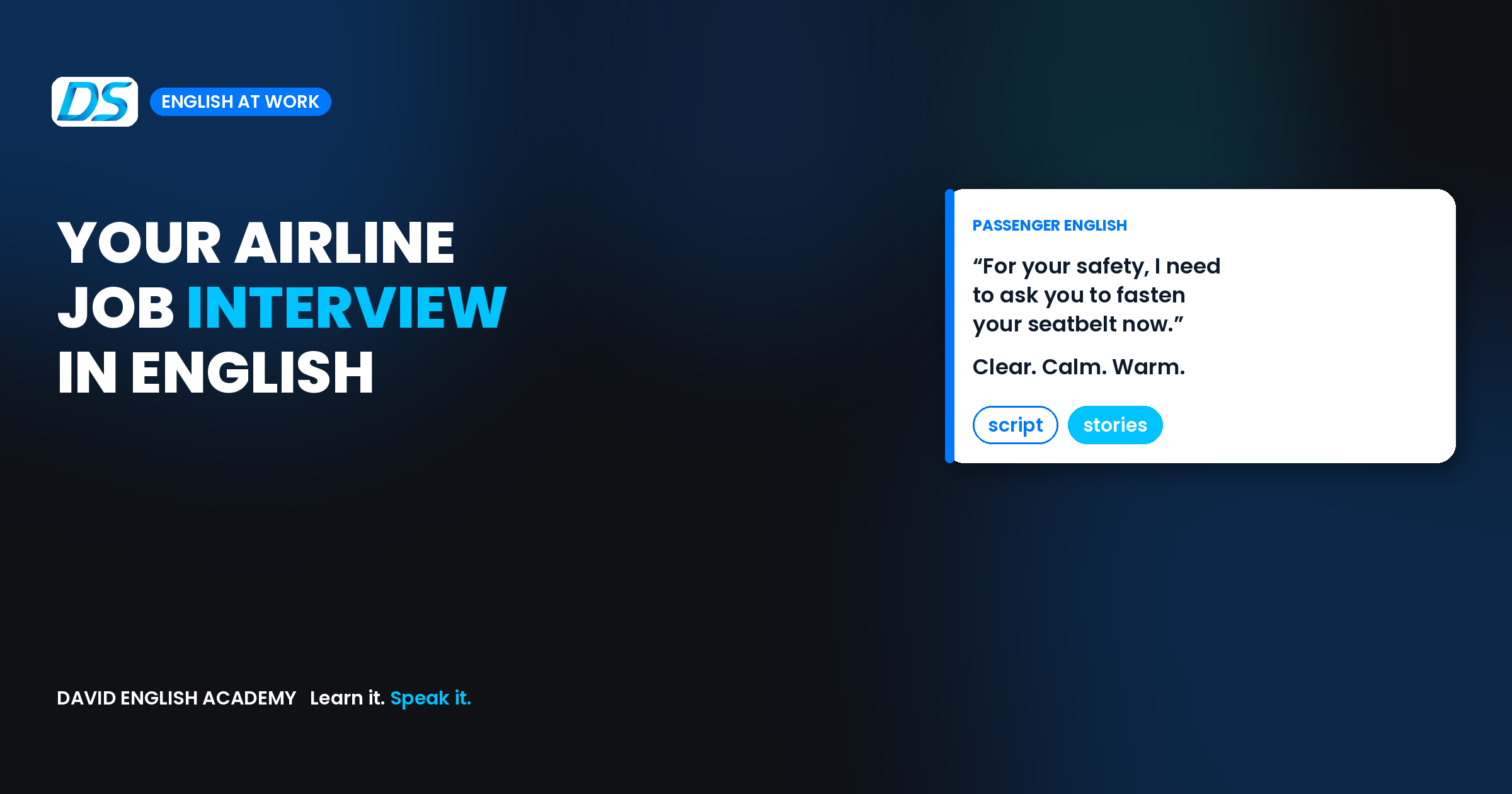
- "For your safety, I need to ask you to fasten your seatbelt now."
- "I understand. Let me check with my colleague and come straight back to you."
Safety phrases for the interview itself
- "That's a great question. Let me think for a moment."
- "Could you repeat the question, please?"
- "For example..."
Mini lesson: choose the word, then the form
Choose the word that fits the situation, then the right form. Say it out loud.
Level 1: Introducing yourself
Words: work / enjoy / bring
"I ___ in hospitality for three years, and I really ___ helping people. I'd love to ___ that experience to your team."
Answer: I've worked in hospitality for three years, and I really enjoy helping people. I'd love to bring that experience to your team. (Present perfect, because you still work in hospitality.)
Level 2: A service story
Words: lose / calm / find
"A guest ___ her passport in the hotel. I ___ her down, and together we ___ it in the restaurant."
Answer: A guest lost her passport in the hotel. I calmed her down, and together we found it in the restaurant.
Level 3: A safety situation
Words: explain / refuse / follow
"A passenger ___ to put his bag under the seat. I politely ___ why it was a safety rule, and he ___ the instruction."
Answer: A passenger refused to put his bag under the seat. I politely explained why it was a safety rule, and he followed the instruction.
Your turn
Answer these out loud, as if the interview is today:
Tell me about yourself in 45 seconds. Then tell me about a time you helped someone who was upset. What did you say? How did it end?
Record yourself on your phone. Listen once. Ask: Was I clear? Did I sound calm and warm? Then say it again, a little shorter and clearer.
How I coach interview English
Interview prep in my lessons is not a memorised script. You speak from day one with stories from your real experience. For each answer you choose the word that fits the situation — service, calm, teamwork — then the form and a simple structure (situation, task, action, result). I correct, coach and build until you sound like yourself under pressure, not like a page you rehearsed.
We use short timed speaking turns (the JAM idea): about 60 seconds per answer, feedback on clarity and warmth, then a tighter second take. That trains passenger English and interview English the same way — clear, calm, complete — whether a human or an AI interviewer is listening.
Mini exercise (do it now): Timer: 60 seconds. Answer out loud: Tell me about a time you helped someone who was upset. Cover what happened, what you did, and how it ended. Listen back once. Cut filler, keep the "I" actions, say it again in 45 seconds.
Your turn: Why do you want to work for an airline? Speak for 60 seconds — clear, warm, no script.
Frequently asked questions
How good does my English need to be for a cabin crew interview?
Good enough that passengers and colleagues understand you clearly, including in stressful moments. Each airline sets its own requirements, so check the job ad. In the interview itself, clear structure and a calm, friendly voice matter more than advanced vocabulary.
Should I memorise my airline interview answers?
Memorise your key points and stories, not every word. Practise them out loud until they feel natural, so you can handle follow-up questions without freezing.
What if I make a mistake in the interview?
Keep going. If it's quick, correct yourself ("Sorry, I helped her") and continue. Staying calm after a small mistake shows exactly the kind of composure airlines look for.
Read next
- Business English for International Meetings: How to Speak Up with Confidence
- How to Measure Your Team's English Progress (Without Fake Stats)
I'm David Sugarman, founder of David English Academy. Born and raised in New York, I've been teaching English since 2011, and today I teach professionals online around the world. Learn it. Speak it. Read more about me, or visit the homepage to explore the courses.